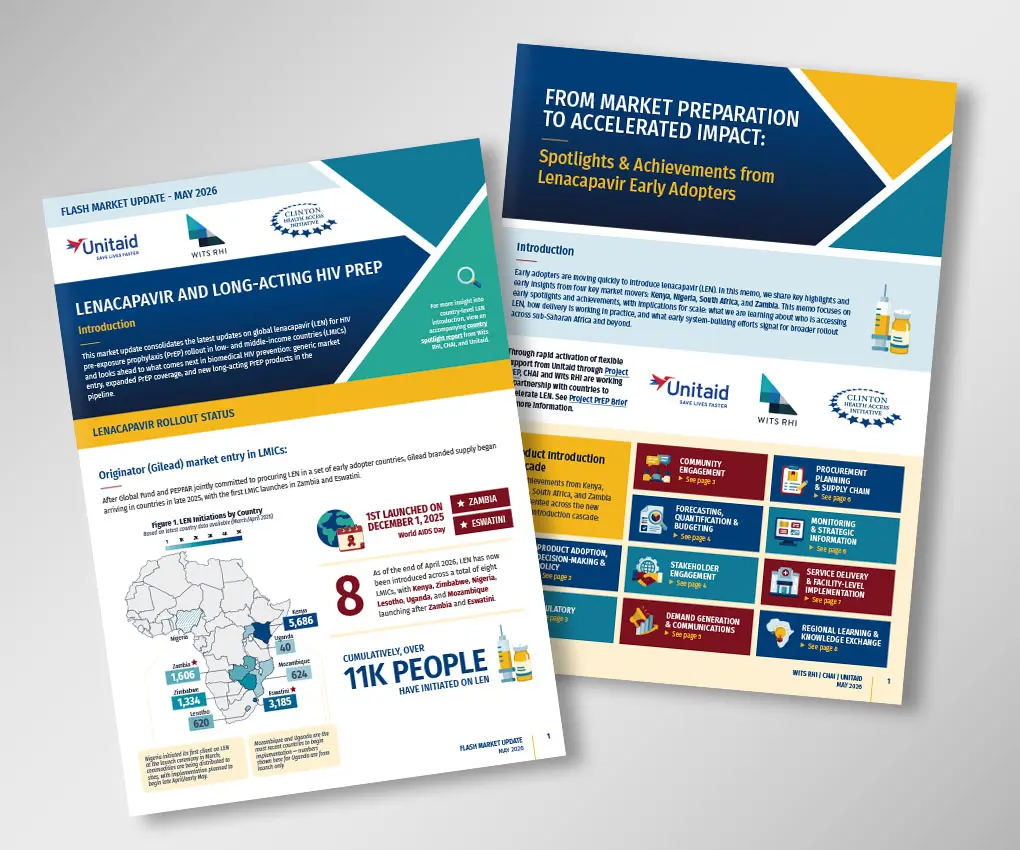
With support from Unitaid, CHAI and Wits RHI have released a Flash Market Update on lenacapavir and long-acting HIV pre-exposure prophylaxis (PrEP). This report tracks rollout progress, the path to generic market entry, and the long-acting prevention pipeline. A companion memo spotlights market preparation and the early rollout of originator lenacapavir in Kenya, Nigeria, South Africa, and Zambia.
Where lenacapavir rollout stands
Following procurement commitments from the Global Fund and PEPFAR, Gilead’s lenacapavir began arriving in low- and middle-income countries in late 2025. Zambia and Eswatini launched on World AIDS Day, Dec. 1, 2025. They became the second and third countries globally to introduce lenacapavir for PrEP after the United States.
By April 2026, eight African countries had introduced lenacapavir for PrEP: Eswatini, Lesotho, Kenya, Mozambique, Nigeria, Uganda, Zambia, and Zimbabwe. Together, they have initiated more than 11,000 people on the drug. Malawi and South Africa received their first shipments in April 2026 and are on track to launch in Q2. Across all ten early adopter countries, we project more than 600,000 people will start lenacapvir this year.
An additional 14 low- and middle-income countries are planning launches by end of 2026 or early 2027. The Global Fund and PEPFAR are supporting these rollouts. Implementation studies in Brazil, South Africa, and Zambia are testing diverse delivery models, including pharmacies, mobile clinics, and community-based approaches. The findings inform broader scale-up.
About Project PrEP
Project PrEP is one investment in Unitaid’s broader portfolio to accelerate access to lenacapavir. Under it, Wits RHI and CHAI partner with generic suppliers, governments, and communities to drive rapid, equitable access to lenacapavir in low- and middle-income countries and expand the PrEP market. The work spans both supply and demand, including generating real-world evidence on lenacapavir delivery to strengthen rollout. It targets three priorities: lowering the cost of the drug, preparing health systems to deliver it, and addressing demand-side barriers that slow scale-up.