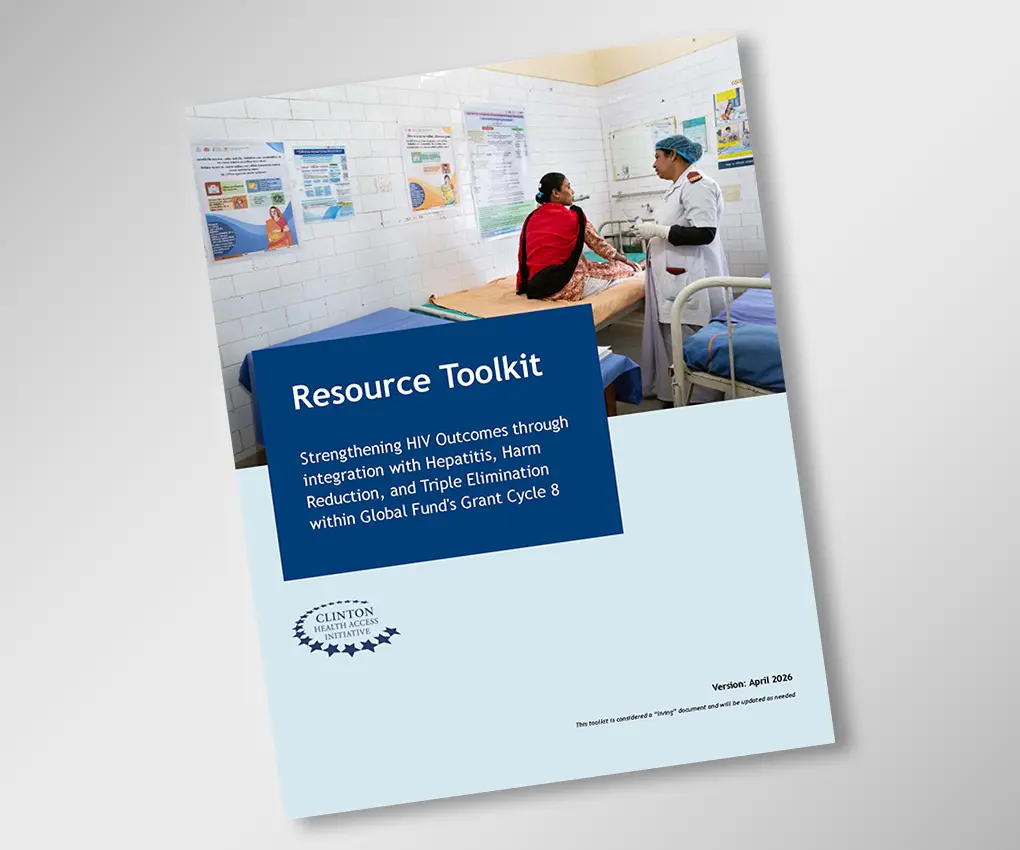
CHAI is pleased to publish the GC8 Integration Toolkit for Hepatitis, Harm Reduction, and Triple Elimination within HIV programming.
With the Eighth Replenishment closing at US$12.64 billion in a constrained and evolving global health financing landscape, Global Fund Grant Cycle 8 (GC8) requires countries to deliver more impact with fewer resources—placing integration, value for money, and sustainability at the center of every investment decision. Investments must demonstrate strong value for money, integrated approaches, and a credible path to domestic sustainability.
At the same time, GC8 provides a strengthened policy basis for integrating viral hepatitis, triple elimination, and harm reduction within HIV programs, as reflected in the GC8 Prioritization Guidance.
This toolkit supports countries to operationalize that shift—providing practical guidance to integrate hepatitis, harm reduction, and triple elimination into HIV programs in ways that are policy-aligned, defensible, and scalable.
A new toolkit to help countries navigate GC8
To support countries in navigating these new priorities, CHAI has developed an updated toolkit to guide the GC8 application process. This toolkit builds on CHAI’s experience supporting countries to navigate integration opportunities in GC7 and align stakeholders around coherent, country-led investment strategies. The toolkit is designed for ministry of health focal points, CCM members, civil society advocates, and technical partners working to position hepatitis, harm reduction, and triple elimination within GC8 funding requests.
The Toolkit provides:
- Population-specific investment guidance organized around three groups—mapping eligible interventions from detection through to treatment and monitoring under GC8’s modular framework.
- Ready-to-use application tools to determine the right level of ambition, build a defensible integrated package, including practical guidance on triple combination test introduction planning.
- GC7 lessons and country illustrations from across Africa and Asia, distilling what worked and what can be strengthened for GC8.
Toolkit resources
The following tools and reference materials accompany the Toolkit. Each is mapped to one or more of the six practical steps outlined in the Toolkit and can be downloaded individually.
Ready-to-use templates:
- Readiness Scorecard: Scoring tool to determine the appropriate level of ambition and primary Program Essential (PE) anchor(s) — applied separately per population group (PE11, PE16, PE3/PE5). Produces a recommended GC8 positioning. Primary audience: CCM leads, technical working groups, technical assistance partners. Relevant step: Step 1 – Build the evidence base
- Country Assessment Template: Structured working template to translate GC8 positioning into a defensible investment case — covering PE anchor selection, current financing map, risk and reprioritization analysis, and PAAR planning. Complete once per population group. Primary audience: Technical working groups, CCM secretariats, principal recipients. Relevant steps: Step 2 – Engage in integrated country dialogue, Step 3 – Map to the Modular Framework, Step 4 – Articulate the Vfm defense, Step 5 – Address the PAAR.
- Sample Advocacy Language: Ready-to-adapt narrative language for the GC8 HIV funding request. Part A covers cross-cutting rationale (integration, VfM, equity). Part B provides population-specific module narrative by PE. Primary audience: Country advocates, civil society representatives, CCM members, technical writers. Relevant steps: Step 2 – Engage in integrated country dialogue, Step 4 – Articulate the VfM defense.
- Costing and Budgeting Guide: Practical costing framework aligned to GC8 Program Essentials — with illustrative unit costs, clear GF-financed vs domestic/partner cost boundaries, commodity guidance, and VfM framing by population group. Primary audience: Finance staff, principal recipients, technical advisors supporting budget development. Relevant steps: Step 4 – Articulate the VfM defense, Step 6 – Choose the submission route
Reference materials:
- GC7 Country Illustrations: Country-level evidence of how hepatitis, HR, and TE were included in GC7 across Africa and Asia — covering context, challenges, what worked, and key implications for GC8. Primary audience: CCM leads, country teams, national hepatitis advocates. Relevant step: Step 1 – Build the evidence base.
- Triple Test Considerations: Guidance on triple combination test (HIV/syphilis/HBsAg) planning within GC8 — product landscape, anticipated WHO pre-qualification timelines, country readiness pathways, and a decision framework for introduction planning. Primary audience: Technical advisors, laboratory teams, hepatitis advocates in countries planning triple test introduction under PE11. Relevant steps: Step 1 – Build the evidence base, Step 3 – Map to the Modular Framework and PEs.
- Module and Activity Mapping: Detailed tables of GC8 modules, interventions, and illustrative activities per population group, drawn from the GC8 HIV Prioritization Guidance and Modular Framework. Includes prioritization status and GF financing boundaries. Primary audience: Technical advisors, program officers, principal recipients. Relevant step: Step 3 – Map to the Modular Framework and PEs.