Updated analysis from CHAI tracks the state of African vaccine manufacturing ambitions in 2026
Africa has long relied on other parts of the world for its vaccines, a vulnerability COVID-19 made impossible to ignore. That crisis galvanized African leaders and international partners to act, prompting the creation of the Partnerships for African Vaccine Manufacturing (PAVM) and setting a formal goal of manufacturing 60 percent of Africa’s vaccines on the continent by 2040. Since then, real progress has been made: facilities have been built, technology transfer partnerships signed, and products are being brought to market.
Africa CDC, CHAI, and PATH have tracked progress through successive landscape assessments in 2023 and 2024, establishing a baseline picture of the realities on the ground. In early 2026, CHAI partnered with Kris Howard, a consultant with 20 years of experience specializing in sustainable vaccine manufacturing in low- and middle-income countries and a widely recognized expert in the space. Together, we engaged 27 manufacturers across Africa following the same methodology used in 2024. What we found is a sector making genuine progress and running into serious headwinds.
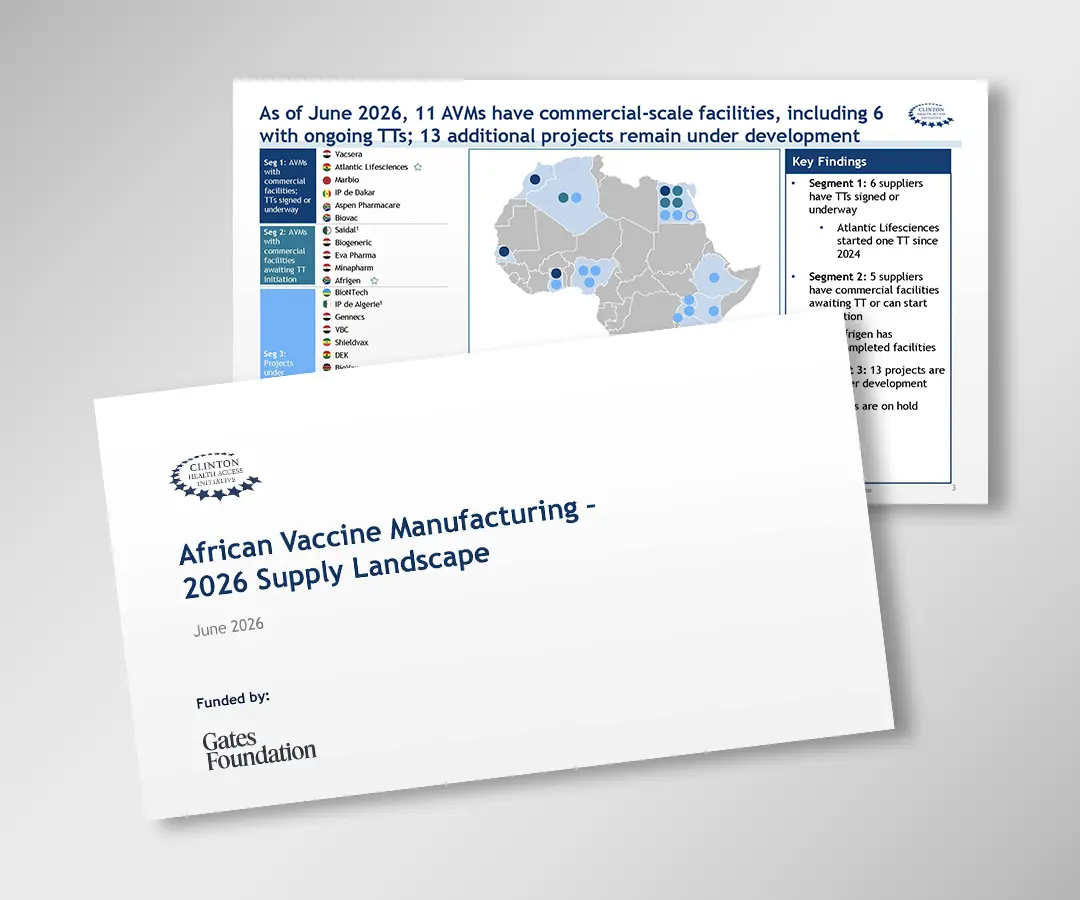
Download 2026 AVM Supply Landscape
Progress is being made
Six manufacturers have built facilities and have active technology transfers underway, including Atlantic Lifesciences in Ghana, which has advanced since 2024. Eleven African-made vaccines are expected to reach the continental market within five years. Several additional vaccines have already been licensed for use in their home countries since the last update in 2024.
Getting approved is only the beginning
But reaching the broader continental market is a different challenge entirely, and World Health Organization (WHO) prequalification, while a critical milestone, is only one-step in a much longer process. After achieving it, a manufacturer must still register in every African country it wants to supply, secure a procurement agreement with UNICEF, and maintain ongoing regulatory approvals—a process that for which we don’t know the expected duration and will look different in every country. Only one African vaccine manufacturer has submitted a filing to its national regulator for a continental product. What comes next, and how long it takes, remains uncertain.
Five challenges compounding each other
Our analysis found five cross-cutting challenges that have already pushed timelines back for some near-to-market manufacturers: regulatory delays, uncertain market demand, slow financing disbursement, delays from technology transfer partners, and workforce gaps. Crucially, we found that a delay in any one area can create risks and delays in the other areas.
What needs to happen
Solving these challenges requires coordinated action across three areas:
- Regulatory: predictable approval timelines, clear pathways after WHO prequalification, and the continued strengthening of national regulatory capacity across the continent.
- Market and demand: clearer demand signals, procurement processes aligned with manufacturer timelines, and pricing conditions that allow manufacturers to sustain their businesses.
- Finance and execution: faster disbursement of committed funding, resources for clinical trials and scale-up, and technical support for workforces.
No single actor can fix this alone. Progress will require manufacturers, governments, donors, and multilateral partners working together in an aligned effort to reduce and remove these barriers.
This work was made possible by funding from the Gates Foundation. The contents do not necessarily reflect the views of the Gates Foundation.