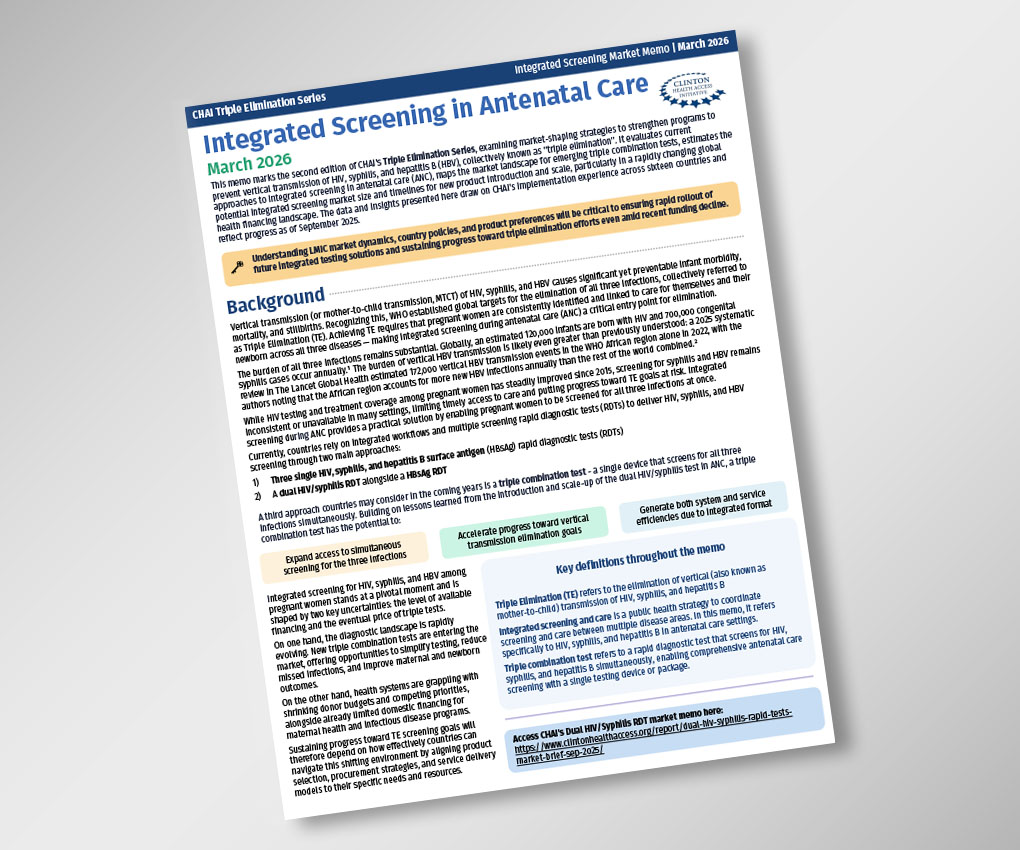
CHAI has released the second edition of our Triple Elimination Series. These market memos examine the diagnostic landscape for preventing vertical transmission of HIV, syphilis, and hepatitis B (HBV). This edition focuses on integrated screening in antenatal care, assessing the emerging market for triple HIV/syphilis/HBV combination tests and modeling market potential under different pricing and financing scenarios, drawing on implementation experience across 16 countries.
Why triple elimination screening is at a critical juncture
Each year, vertical transmission of HIV, syphilis, and HBV causes significant but preventable infant morbidity, mortality, and stillbirths—particularly in sub-Saharan Africa. HIV and syphilis screening coverage at antenatal care have improved substantially. HBV screening lags far behind at just 44 percent across CHAI’s focus countries—roughly half that the rate seen for HIV and syphilis.
Integrated screening for all three diseases offers a practical path forward. However, the landscape is shaped by two key uncertainties. The first is the level of available financing. The second, the eventual price of triple combination tests. New diagnostics are entering the market with the potential to simplify testing workflows and reduce missed infections. But health systems are simultaneously grappling with shrinking donor budgets and limited domestic financing for maternal health programs.
Key findings across 16 countries
CHAI’s analysis, combining qualitative research and quantitative market modeling under three financing scenarios, surfaces several important insights for policymakers, procurement agencies, and global health funders.
Demand is strong, but product diversity matters. All 16 countries assessed are already conducting integrated HIV, syphilis, and HBV screening in antenatal care. These countries would consider adopting a triple combination test. Variation in preferred test formats, however, highlights the need for a diversified product pipeline.
Scale-up timelines require deliberate acceleration. Countries estimate that national adoption of triple tests could take 3.5 to 9.5 years from product approval. This is due primarily to validation and guideline revision requirements. Early planning, aligned evidence generation, and coordinated implementation support are critical to shortening this timeline.
Price is the pivotal variable for triple elimination progress. At approximately US$1 per test, triple combination tests can be more cost-effective than existing single and dual products. This could significantly expand HBV screening coverage without eroding HIV and syphilis gains. At higher price points, constrained budgets may render triple tests unviable at scale, risking reductions in total testing volumes and reversals in hard-won HIV and syphilis coverage. In the absence of affordable triple tests, HBV screening is projected to decline sharply under funding pressure and may not recover.
Looking forward
Integrated screening for HIV, syphilis, and HBV is already underway, providing a strong foundation on which to build. But that progress is at risk amid tightening donor budgets.
Triple combination tests represent a timely opportunity to protect and extend gains by simplifying service delivery and closing persistent gaps, particularly for HBV screening. Realizing this will require coordinated action across evidence generation, financing, and implementation, along with the market shaping needed to achieve an accessible price point.