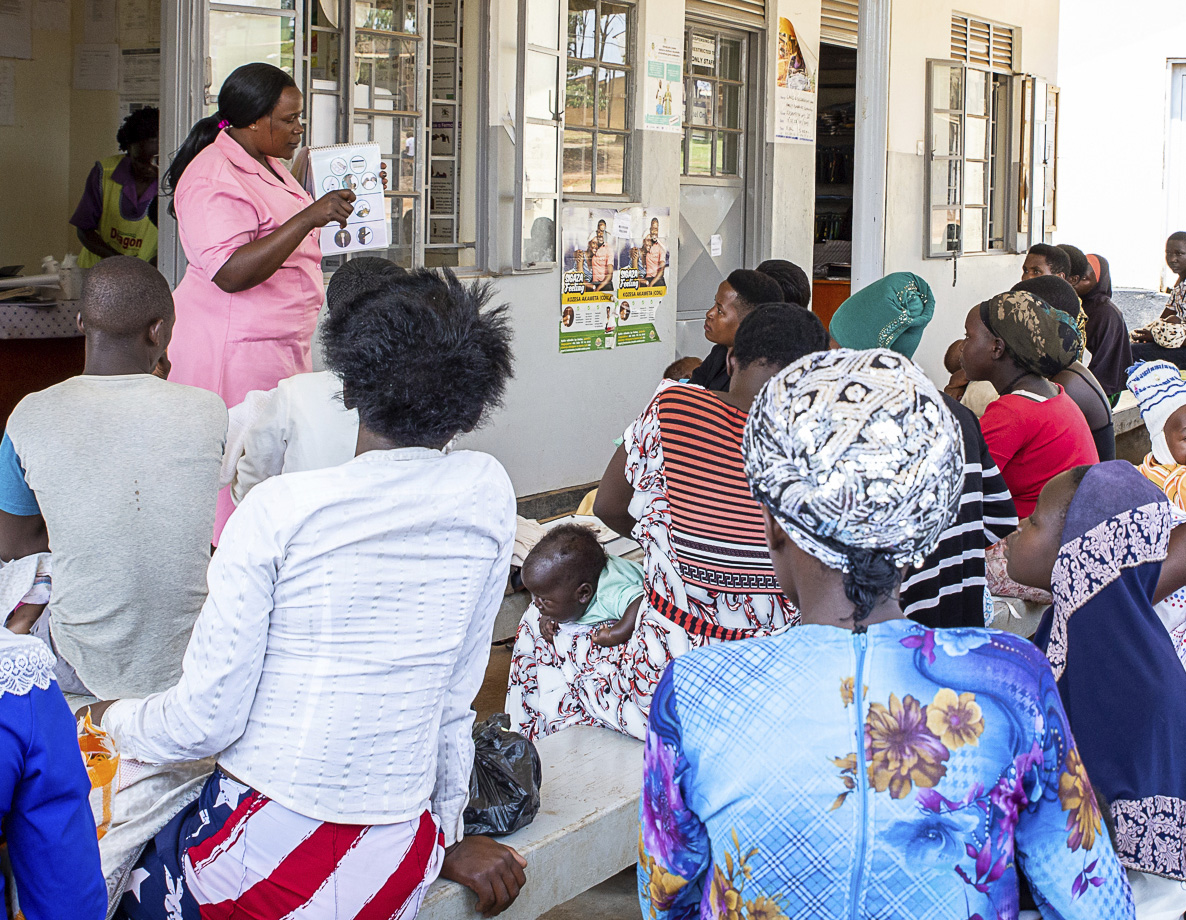
What should’ve been cries of joy over meeting her firstborn child quickly turned into despair for Olusola Bola. In the dimly lit room of a local birth attendant’s home, she not only lost her baby, but came terrifyingly close to losing her own life.
She had come, despite knowing the risks. The cost of care and transportation to the hospital was far beyond her reach. So, she made a desperate choice, turning what would have been a celebration of a new life into heartbreak.
Trapped by the same financial hardships, Bola made the same choice with her second pregnancy.
Her story isn’t unique. In Nigeria, one in eight children doesn’t make it to their fifth birthday. The first two months are the most dangerous—67 out of every thousand babies don’t survive. For mothers, the risks are just as real: about 1 in every 200 women dies from childbirth. These deaths are often preventable if mothers like Bola had health insurance coverage—something Nigeria is working to change.
High out-of-pocket costs force women to make life or death decisions
However, for millions of Nigerian women, seeking healthcare means choosing between impossible options: pay for a hospital visit or feed your family for the week. Skip the doctor or lose a day’s wages you can’t afford to lose.
Nigerians pay over 77 percent of healthcare expenses out of pocket—one of the highest rates in the world. For the poorest families, healthcare isn’t just expensive. It’s completely out of reach.
Even when families can scrape together money for care, getting to a facility can take hours. This is what experts call the three delays—delays in deciding to seek care, delays in reaching a facility, and delays in receiving adequate treatment. Each delay can be fatal.
Nigeria had a solution—but it wasn’t reaching people
In 2014, Nigeria created the Basic Health Care Provision Fund (BHCPF)—essentially a health insurance program funded with one percent of national revenues to cover vulnerable populations. On paper, it was exactly what women like Bola needed: free maternal and child health services. But more than 10 years later, less than two percent of Nigeria’s vulnerable populations were enrolled1.
A partnership to build sustainable systems
This is where Global Affairs Canada (GAC) and CHAI tried something different.
Rather than simply funding enrollment, GAC supported CHAI to work with six Nigerian states, Bayelsa, Ekiti, Kaduna, Katsina, Niger, and Ondo, to build their capacity to run health insurance programs themselves. The goal was sustainability: create systems that would continue growing long after external funding ended.
Here’s what that looked like on the ground:
Building local expertise. CHAI trained nearly 1,100 facility managers and over 250 mentors on how to implement the health insurance fund—everything from enrolling beneficiaries to delivering maternal care to managing facilities.
Demonstrate what’s possible. Using GAC funding, CHAI enrolled over 131,000 pregnant women and children under five. This proved to state governments that reaching vulnerable populations at scale was actually feasible.
Planning for the long term. From day one, CHAI required states to commit their own funding and develop expansion plans with specific targets and budgets. This ensured states would continue enrollment beyond GAC support.
As a result, over one million people now have access to free healthcare across the six states.
Health insurance coverage in Nigeria increased 301 percent across these states—from 281,629 people to 1,130,718. This tripled health insurance coverage for Nigeria’s most vulnerable groups.
Most of that growth happened through state funding and efforts, not donor money. The states built the capacity to scale up their own resources—exactly what GAC’s investment aimed to achieve.
“Our state has historically struggled with high maternal and child mortality rates,” said Saidu Bala, a pharmacist and director at Kaduna’s health insurance agency. “This program has given us a solid foundation to tackle these issues head-on by covering costs for the most vulnerable.”
Lessons for achieving universal health coverage
This story offers an important lesson: sustainable change requires building local capacity, not just providing temporary funding.
GAC’s strategic investment created a multiplier effect. The initial funding didn’t just help 131,000 people—it created systems that helped over a million people and continue growing.
Six Nigerian states now have trained staff who know how to run health insurance programs, proven enrolment models that work, detailed plans for continued expansion, and the confidence that universal health coverage is achievable.
“This program is transforming lives by drastically reducing out-of-pocket expenses for healthcare,” said Bala, observing the impact in Kaduna.
What comes next
The program officially transitioned to full management by the states in November 2025. Rather than an ending, this represents a beginning—states positioned to continue scaling enrolment using their own funding and the systems they’ve built with GAC and CHAI support.
For individual families the change is dramatic.
One mother accessing the program explained that when her son used to get sick, she could only afford to buy small doses of medication from the pharmacy. Now that he gets full treatment through insurance, he recovers faster and stays healthier longer.
“I used to rely on home births due to financial constraints,” explained Barilah Aliyu, another mother who uses the program in Katsina State. “But this program provided me with full support during my hospital delivery, including care for postpartum complications.”
For women like Aliyu and Bola, this means a future where financial barriers don’t determine who lives and who dies during childbirth. Where children get full doses of medicine instead of split pills. Where healthcare is a right, not a luxury.
That’s what universal health coverage looks like in practice. And it’s what happens when you invest in building systems that last.